- +1 866-935-4226
- admin@elhaamacademy.org
- 87 41 165th St, Queens, NY, United States,11432
Academics Academics Academics |
academics Overview

Elhaam Academy provides a rigorous, values-grounded academic program that integrates a STEAM-focused curriculum across all grade levels. Instruction is designed to develop strong foundational skills, critical thinking, and problem-solving while supporting students’ intellectual, ethical, and spiritual growth. Our approach balances academic excellence with Islamic values, preparing students to succeed academically while developing character, responsibility, and purpose.
LOWER ELEMENTARY
Grades 3–5
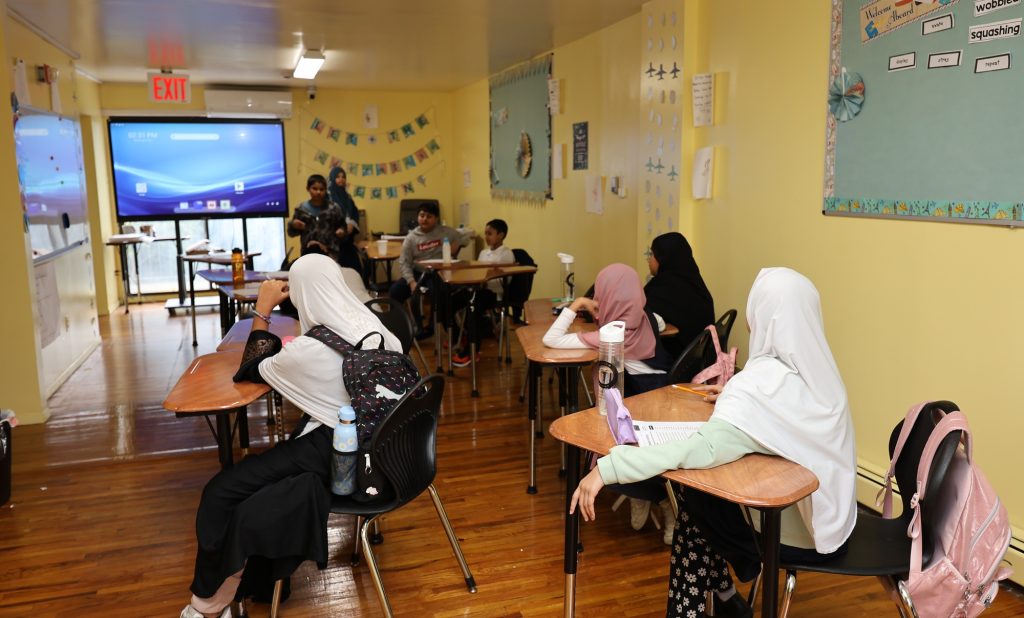
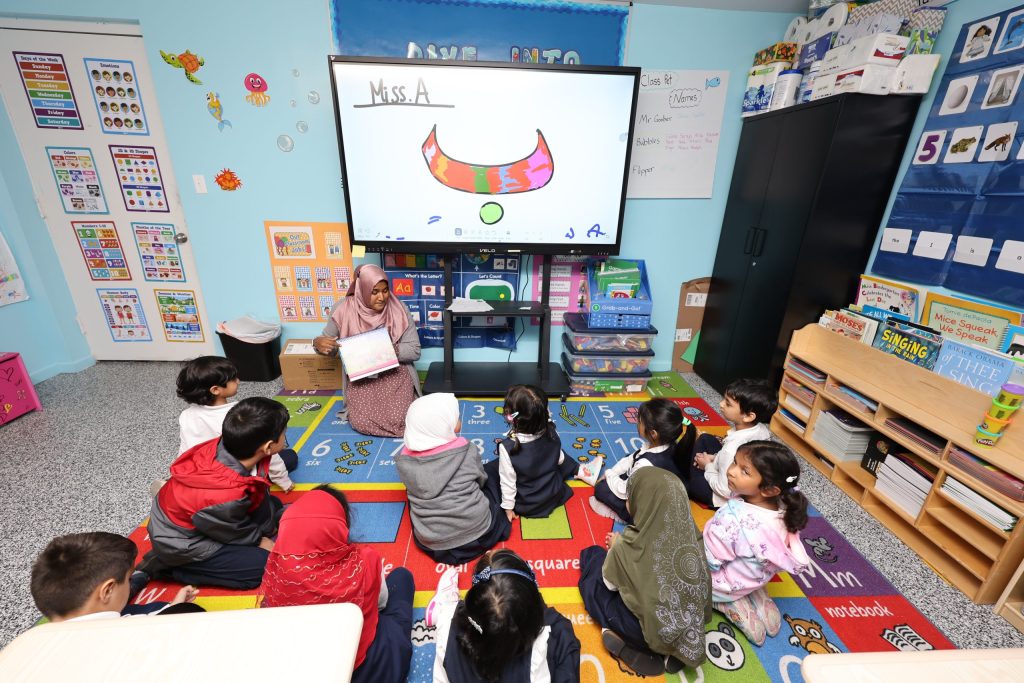
The lower elementary program provides a nurturing and structured environment where young learners develop foundational academic and social skills. Instruction is developmentally appropriate and supports curiosity, creativity, and a positive relationship with learning.
UPPER ELEMENTARY
Grades 3–5
The upper elementary program introduces a more structured academic experience while maintaining hands-on and inquiry-based learning. Students strengthen core skills across all subject areas and begin applying knowledge in more complex ways.
MIDDLE SCHOOL
Grades 6–8
The middle school program supports the development of academic rigor, independence, and
critical thinking. Instruction prepares students for high school expectations while reinforcing
strong study habits, responsibility, and ethical reasoning.
Academics details
LOWER ELEMENTARY
Grades K–2
Curriculum Overview
Mathematics
Students build number sense through counting, place value, basic addition and subtraction, shapes, patterns, and measurement. Instruction uses hands-on manipulatives, interactive activities, and guided practice to strengthen mathematical understanding.
English Language Arts
Instruction focuses on phonics, letter recognition, early reading, vocabulary development, and storytelling. Students participate in read-alouds, guided reading, phonics activities, and early writing experiences.
Science
Students explore the natural world through topics such as plants, animals, weather, and the five senses. Learning includes observation, simple experiments, nature exploration, and hands-on investigations.
Social Studies
Students learn about themselves, their families, their communities, and basic geography. Instruction includes storytelling, role-playing, and interactive activities that build social awareness and understanding.
UPPER ELEMENTARY
Grades 3–5
Curriculum Overview
Mathematics
Students study multiplication and division, fractions and decimals, geometry, data analysis, and
introductory algebraic thinking. Instruction emphasizes problem solving, reasoning, and
mathematical communication.
English Language Arts
Students develop advanced reading comprehension, grammar, vocabulary, and multi-paragraph
writing. Instruction includes literature study, writing workshops, oral presentations, and
structured discussion.
Science
Students explore ecosystems, the water cycle, basic chemistry, and human body systems.
Learning includes experiments, projects, and inquiry-based investigations.
Social Studies
Students study United States history, world geography, government, and cultural studies.
Instruction includes research projects, map analysis, and historical inquiry.
MIDDLE SCHOOL
Grades 6–8
Curriculum Overview
Humanities
English language arts and history are taught through an integrated humanities approach.
Students engage with complex texts, analytical writing, discussion, and historical inquiry to
strengthen literacy, reasoning, and communication skills.
Mathematics
Instruction advances toward pre-algebra and algebraic thinking, emphasizing problem-solving,
logical reasoning, and the application of mathematical concepts.
Science and Technology
Students continue a STEAM-focused approach through scientific investigation, data analysis,
and technology integration. Learning emphasizes inquiry, experimentation, and real-world
application.
STEAM Focus Focus Focus |
Our STEAM curriculum is integrated across all grade levels, ensuring that students develop a deep understanding of science, technology, engineering, art and mathematics.
We use problem and project-based learning to connect theoretical knowledge with real-world applications.We pride ourselves in having all teachers trained in integrating Islamic knowledge across the curriculum.
Students are challeneged to pose questions to real life problems, conduct research, and create solutions that solve problems.
Islamic Curriculum
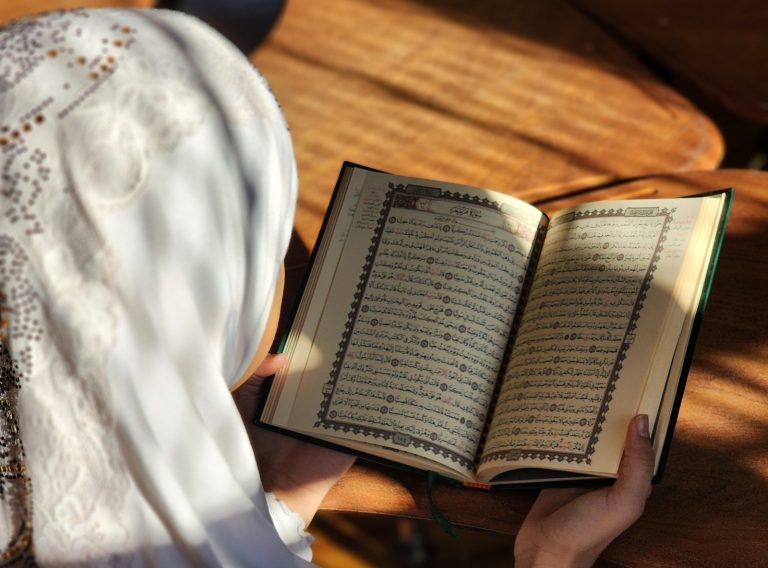
Qur’an, Arabic, and Islamic Studies are central to the Elhaam Academy program. Instruction is grounded in the Qur’an and Prophetic tradition, providing students with a strong moral and
ethical framework.
Islamic Curriculum
Quranic Studies
Students learn to read, memorize, and understand the Qur’an with accuracy and proper
recitation. Instruction is differentiated to meet individual student needs and emphasizes the
application of Qur’anic teachings in daily life.
Islamic Studies
Students study beliefs, worship, character, and manners through topics such as aqeedah,
hadith, seerah, Islamic history, and ethics. Instruction supports spiritual development, moral
reasoning, and personal responsibility.
Arabic Language
Students are taught Modern Standard Arabic as a second language. Instruction is leveled
based on student proficiency and supports reading, writing, speaking, and comprehension.
Arabic learning strengthens linguistic skills and deepens students’ connection to Islamic texts.
Contact Elhaam Academy to learn more about our academic program.